
July 9, 2025
Stay strong: Why strength training remains important as we age
Share


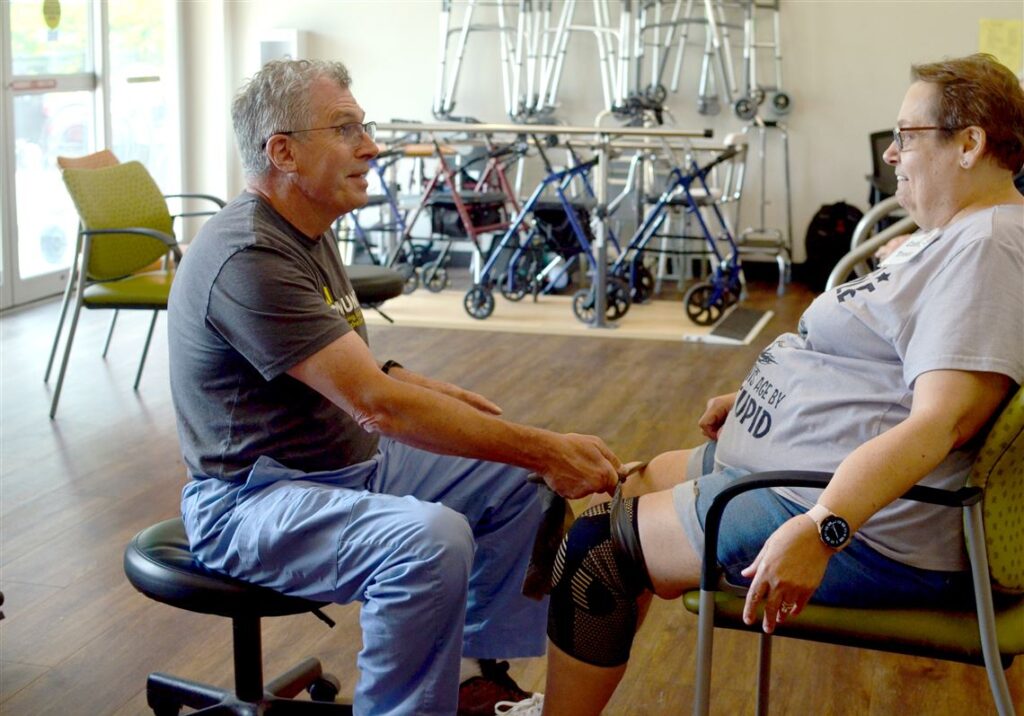
‘We know that with resistance training, we can directly make changes to our strength and our power’
Seventy-year-old Richard “Guppy” Glucs winced as his physical therapist stretched his calves.
“I shouldn’t even be here, according to the ER doc,” he said on a recent Tuesday at Community LIFE in New Kensington as his physical therapist stretched him out. “My blood pressure was so high.”
Glucs is part of a close-knit group of people who receive care from Larry Satariano, physical therapy supervisor at the independent living facility Community LIFE, which has locations throughout southwestern Pennsylvania. Satariano creates customized exercise programs for those who visit the LIFE center.
Paramount to those programs is strength training, tailored to each person’s medical history and current abilities.
“Our bodies have so much inherent ability, and up until the very end of our lives, we will get strength gains and improve cardiovascular fitness with consistent training,” he said. “So even if people come in and they’re very limited, you can almost always make somebody better, and that is what we really try to do.”
Strength and resistance training carry a variety of benefits as we age. The body starts losing muscle mass at around age 30, per Harvard Health, so starting to incorporate a strength-focused routine into weekly exercise can slow that muscle loss and the consequences that accompany it.
“As we age, we see a loss, mostly in the Type 2 muscle fibers, and these are the muscle fibers that produce large and powerful force,” said Emily Pauley, a physical therapist with UPMC. “What we see then is difficulty getting up from a chair, getting up the stairs, those things that require power. So with resistance training, you can focus on strength, you can focus on endurance, you can focus on power.
“We know that with resistance training, we can directly make changes to our strength and our power,” she added.
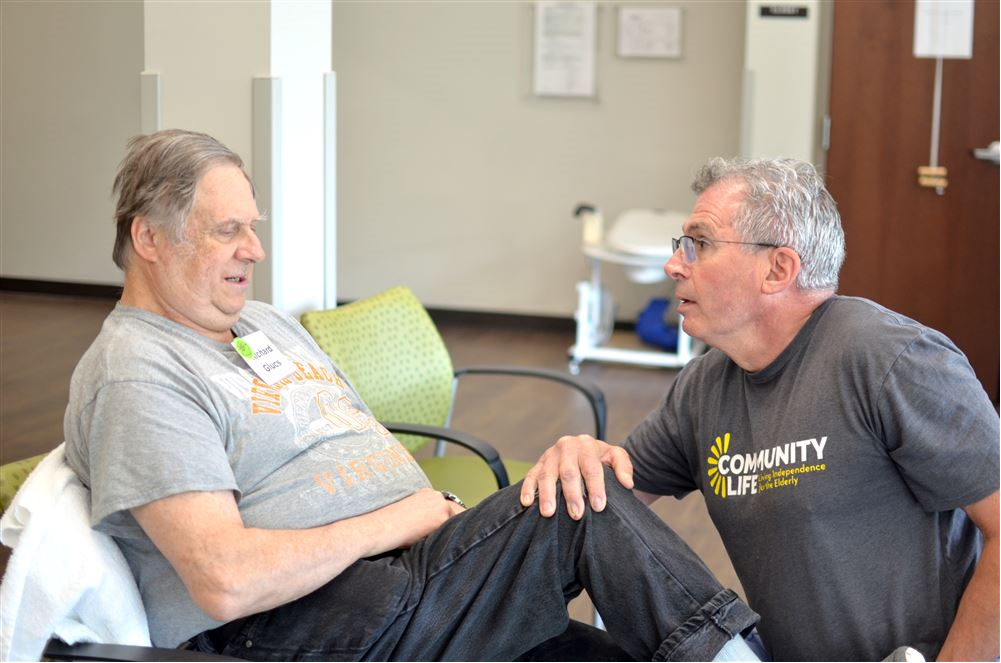
Community LIFE physical therapist Larry Satariano speaks with Richard “Guppy” Glucs, 70, who is working on stretching and strength training after breaking his ankle.(Hanna Webster/Post-Gazette)
Adults should get 2 ½ hours of moderate to vigorous exercise a week, per the Office of Disease Prevention and Health Promotion, an agency under the U.S. Department of Health and Human Services. For older adults specifically, that exercise should include balance training, aerobic exercise and muscle strengthening — and of course be adapted depending on any comorbidities or mobility issues a person has.
Those 2 ½ hours can translate to about two to three days of exercise a week and a variety of activities, including light strength training, said Kim Kelley, physical therapist at Allegheny Health Network and coordinator of AHN’s concussion therapy services.
Strength training not only can improve muscle strength but also cognition, memory, depression, blood pressure and bone strength and balance, helping to prevent falls and fractures.
The latter was a weak link for Glucs, who broke his ankle tripping down the stairs seven years ago. He’s been coming to Community LIFE and attending physical therapy with Satariano for six of those years.
At the emergency room after his fall, Glucs said doctors found blood clots in his legs and diagnosed him with hypertension.
Glucs’ tailored program relies heavily on pain management and stretching, said Satariano, while straightening Glucs’ leg after holding his foot in a flexed position.
“He has really maintained this level for the past five years,” said Satariano. “That’s the beauty of exercise. He’s basically stopped time.”
Part of aging often includes developing chronic pain or a chronic condition. “When you get older, you are probably going to hurt,” said Satariano. “Society doesn’t really prepare us for that.”
More than half of adults over the age of 60 report having high blood pressure, and about half note having arthritis or high cholesterol, per a 2023 report profiling older Americans, conducted by the Administration for Community Living, within the U.S. Department of Health and Human Services. A majority of older Americans stated they had a chronic condition, and many had multiple, per the survey.
“Most of our patients come in saying something about arthritic changes,” said Kelley. “We work on building the muscle tone around that arthritic joint to relieve pain. We can’t go back and reverse arthritis, but we can support the joint with the muscle around it.”
Chronic pain can compound mental health stress, further leading to vulnerability for older Americans.
“It’s easy as we age to seclude ourselves,” said Pauley. “And with that, you see a deterioration in mental health. It’s harder to do things, harder to get out of bed. Keeping older adults linked in with groups and linked in with each other, having a younger trainer that can keep them on top of their strength training, it’s just a good way to keep them participatory.”
It’s one aspect of Community LIFE’s mission as well. On thatTuesday, patients gathered in a common area for a Wii bowling league game, their stances steady as they swung the remote. Some wore matching league shirts, with “Great Balls of Fire” in cursive on the back.
And in the physical therapy room, patients sit together, receiving care from orthopaedic specialists and Sartiano and chatting amongst themselves.
“We’re like a family,” said Sartiano. Gesturing to Glucs, he said, “I know this guy in and out.”
Part of strength training, for those over 60 especially, involves translating these movements in the PT room to activities of daily living, said experts. It’s not just about lifting weights, but about carrying your grandbaby, going up the stairs and standing from a seated position.
“If we have the strength and the capability to do the things we want, we are more apt to go out into the community, go to dinner with friends,” said Kelley. “Sometimes increased depression comes from seclusion and lack of community involvement, or if you’re in pain or uncomfortable, patients tend to not go out as much. If you can maintain your ability, you may be more willing to step out and participate.”
While aging-related decline may start earlier than one might expect, building back muscle may be easier too.
Kelley, Satariano and Pauley start patients without strength training experience — or those with comorbidities or a high risk of falls — with simple movements, such as calf raises while holding on to the countertop, wall push-ups or biceps curls with cans of soup.
“There are all kinds of ways to strength train,” said Pauley. “Any strength training is beneficial, from home-based programs to community classes.”
And it’s never too late — or too early — to start.
“Any age is a good age to start doing any kind of exercise,” said Osvaldo Navia, chief of geriatrics at West Virginia University Medicine and an associate professor. “If you have good health and you start doing this in your 20s or 30s, it’s going to become a routine in your life, and the transition won’t be quite as difficult.
“Don’t wait until you have an acute event like heart attack or stroke to change your habits.”

HANNA WEBSTER
Pittsburgh Post-Gazette
JUL 6, 2025
First Published: July 6, 2025, 4:00 a.m.
Updated: July 7, 2025, 11:48 a.m.

